
Published · Updated
In short: Google has explained how AI Overviews and AI Mode choose content: they are built on the same ranking and quality systems as classic search. Good SEO therefore remains the foundation. What is new is that you need to be not only found but also cited, in Google and in ChatGPT, Gemini or Perplexity. Content with first-hand experience, your own data and a clear structure succeeds best. Here is what Google says, what it means for businesses and what we see in our own data.
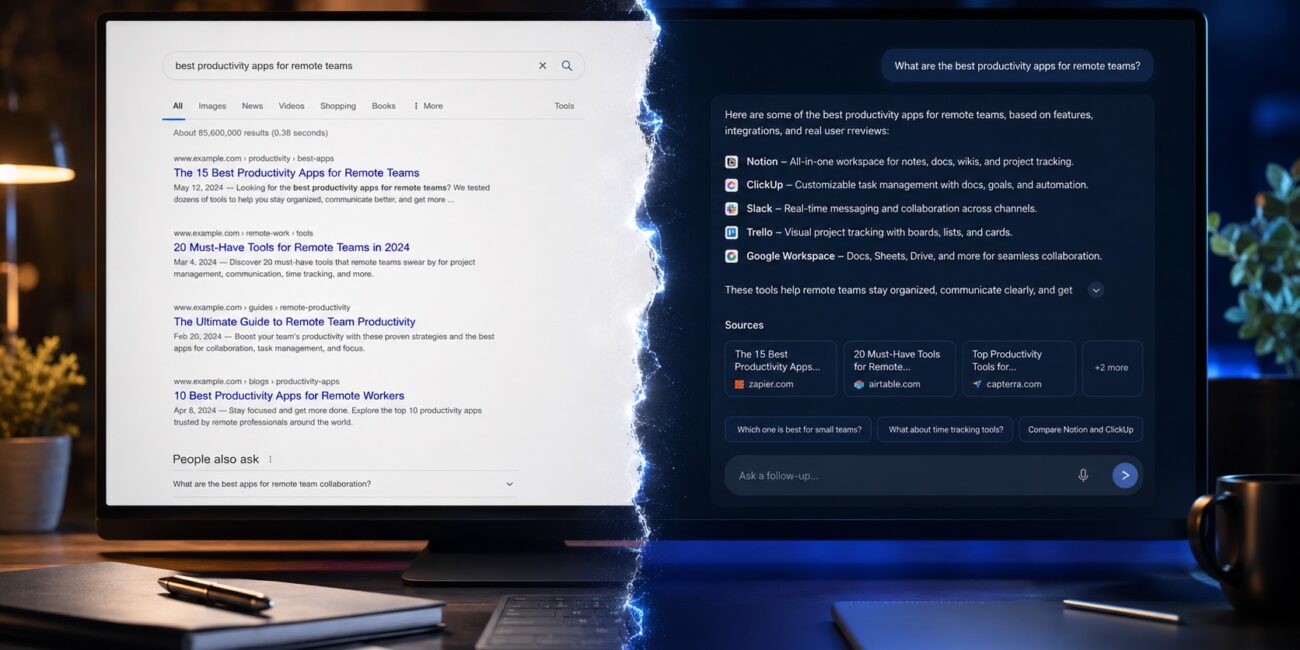
Many companies have noticed the same thing for months: rankings are stable, articles go out regularly, and yet organic traffic is falling. The reason is usually not bad SEO but the way people search today. They ask ChatGPT, Gemini or Perplexity directly, and even in Google they often get the answer in the AI Overview without clicking on a website. That is why everyone is talking about GEO. Since August 2026, businesses can also reach these people with advertising in ChatGPT.
What is GEO and how is it different from SEO?
GEO stands for generative engine optimisation, optimising content for generative AI systems. Classic SEO follows a simple principle: rank as high as possible, win the click, bring the visitor to your website. GEO adds another question: does the AI mention you, recommend you or use you as a source in its answer? Being relevant is not enough. You have to be citable.
| SEO | GEO | |
|---|---|---|
| Goal | position in search results and the click | mention and recommendation in the AI answer |
| Where | Google, Bing | AI Overviews, AI Mode, ChatGPT, Gemini, Perplexity, Copilot |
| What counts | relevance, technical quality, backlinks | also: brand trust, your own data, clear answers, mentions outside your website |
Google itself does not see this as a completely new discipline. In its view, optimising for generative search is part of broader SEO. That is good news: if you have solid SEO foundations, you are not starting from zero.
How Google chooses content for AI answers
Google describes two principles worth knowing for your content strategy.
1. Retrieval-augmented generation (RAG)
The AI answer is not based only on what the model “knows”. Google first retrieves relevant, current pages from its index and then builds the answer from them. So websites still matter: your content can become part of the answer if it is indexable, high quality and relevant.
2. Query fan-out
For a single question, the system automatically creates several related sub-questions. Someone asking how to get rid of weeds in their lawn gets an answer for which Google also searched for herbicides, natural methods, prevention and lawn care. For your content this means one article targeting a single narrow phrase is often not enough. Websites that cover a topic in depth, answer follow-up questions and build topical authority over time have the advantage.
E-E-A-T matters even more
Experience, Expertise, Authoritativeness and Trustworthiness decide whether your content looks trustworthy to Google and to AI systems. Rewriting three competitor articles no longer works, because AI sees that kind of content everywhere. When two authors write about the same topic, the one more likely to win:
- has real hands-on experience,
- gives concrete examples,
- works with their own data or results,
- is cited outside their own website,
- builds expertise in one field over the long term.
Commodity content loses
Google talks about “non-commodity content”: content that is not just the hundredth generic answer to a topic. A typical “7 tips for …” article can be formally correct and still interchangeable. Content built on first-hand experience, a clear point of view and your own numbers is something nobody can write after five minutes of research.
Can you use AI to write content?
Yes. Google has no problem with AI helping with research, outlines or structure. The problem starts when AI mass-produces pages without real value for users, which Google may treat as “scaled content abuse”. The rule for businesses is simple: use AI, but never publish without human review. Check facts, add your own experience, adjust the tone. The same applies to title tags, meta descriptions, structured data, alt text and product descriptions.
What Google says you do not need
- No special AI files for Google: according to Google, you do not need dedicated AI text files to appear in generative Google Search. An llms.txt can still be a cheap, sensible addition for other AI systems, but it does not replace good content.
- No artificial chunking: Google understands the context of a page and picks the relevant section itself.
- No special “AI writing style”: the systems understand synonyms and context. Writing clearly, factually and helpfully is enough.
- No special schema just for AI: structured data remains useful, but there is no schema.org markup needed only for AI search.
- No bought or artificial mentions: Google detects spam here too.
Want ChatGPT to recommend you? See how it works →
What we see in our own data
For several months, our website’s Google Search Console has shown queries no human would type, such as “search the web and find current information: how to choose a marketing agency”. These clearly come from AI assistants researching the web live for their answers. Two things follow from this:
- AI assistants actively look for current sources, in the user’s language. If you have no content on a topic in that language, you cannot be a source at all.
- The queries are long and describe a situation. Content that answers exactly such questions directly has the best chance of being cited.
We measure AI visibility from three sources: visits from chatgpt.com, perplexity.ai, gemini.google.com and copilot.microsoft.com in Google Analytics 4, long conversational queries in Search Console, and regular tests of how ChatGPT, Gemini and Perplexity answer our clients’ most important questions.
Is your website ready for GEO? A 5-question check
- Does your content answer specific customer questions? Can a reader find the answer within 10 seconds? AI rarely cites generic phrases without a clear answer.
- Does your website have clear topical authority? AI evaluates the overall context. If you write about everything, the algorithm sees you as an expert in nothing.
- Are you mentioned outside your website? Expert articles, interviews, reviews and case studies on other websites are to GEO what backlinks are to SEO.
- Is your content well structured? Clear headings, FAQs, specific numbers and definitions help AI understand it.
- Do you know what AI says about you today? Ask ChatGPT, Gemini and Perplexity about your industry, your services and your name. Does AI mention you, and is the information correct?
Frequently asked questions about GEO
Should I stop doing SEO and switch to GEO?
No. GEO extends SEO, it does not replace it. Websites with good technical foundations, authority and quality content are also best placed for GEO.
How quickly does GEO work?
Technical changes and structured data take effect as soon as search engines and AI crawl the website again, often within a few weeks. Trust and mentions outside your website build up over months.
Is GEO worth it for smaller and local businesses?
Yes, especially for them. AI assistants increasingly answer questions like “best accountant in Manchester”. Businesses with clearly described services, location and expertise have a real chance of being mentioned.
Conclusion
Google’s guide contains no magic trick. It confirms what experienced marketers have been saying for a long time: the future does not belong to those who publish the most, but to those who are trusted the most. Every article needs a clear reason to exist.
If you want to know what ChatGPT, Gemini and Google’s AI Overviews say about your business today, we are happy to take a look. Find out more about our AI search optimisation (GEO) and SEO services. The first 60 minutes of consulting are free: book a consultation.
Sources: Google Search Central: AI features and your website, Google Search Essentials, Google: Creating helpful, reliable, people-first content

Want ChatGPT to recommend you?
We help AI search engines know and recommend you when people ask about services like yours.
AI search optimisation (GEO)or book a free 60 minute consultation