
Published
In short: Since 31 August 2026, businesses in 31 European countries can advertise directly in ChatGPT. Ads appear below ChatGPT’s answer, are delivered using Context Hints instead of keywords and cost at least €15 per day. We tested the channel on our own account and share the real numbers below.
Advertising in ChatGPT is no longer a side experiment. According to OpenAI, ChatGPT’s ad business reached an annualised revenue run rate of 1 billion US dollars less than 200 days after launch. By October 2026, OpenAI said ads were sold in 89 countries and more than 100,000 advertisers had used the platform. So what is behind it, how does advertising inside an AI conversation work, and is it worth testing now?
From the US to Europe in six months
OpenAI launched ads in ChatGPT in the United States on 9 February 2026. Six months later came the biggest expansion since launch: 31 European countries. Since 31 August 2026, the self-service Ads Manager has also been available to European advertisers.
What makes it interesting is the moment the ad appears. In ChatGPT people rarely type two keywords as they do in Google. They describe their problem, requirements and budget, and then compare options. That is exactly the stage at which a relevant ad can appear.
How does advertising in ChatGPT work?
ChatGPT answers the question first. Only below the answer can a clearly labelled sponsored ad appear, the so-called Chat Card. It contains the brand name, logo, a headline, short text, an image and a link to the landing page. The limits are strict: the headline can have up to 50 characters (16 to 24 are recommended) and the ad text up to 100 characters.
An example: someone writes “I’m looking for accounting software for a small business that handles invoices and stock.” ChatGPT answers, and below the answer an ad for relevant accounting software may appear. The difference from classic PPC is not only where the ad appears, but the context that comes before it.

Context Hints instead of keywords
Instead of keywords and match types, advertisers describe in full sentences what they offer, whom they help and in which situation they are relevant. For accounting software, a Context Hint could be: “Accounting software for growing retailers that need to connect online and in-store sales.”
OpenAI stresses that Context Hints are not fixed targeting rules. The user does not have to write the same sentence, and a hint does not guarantee delivery. The system uses it as an additional relevance signal. This brings advertising closer to the user’s intent and situation than to a single word.
Ads do not influence the answers
According to OpenAI, ads are clearly separated from answers, and nobody can pay for ChatGPT to recommend a brand in the answer itself. Advertisers have no access to private conversations. For businesses these are two different disciplines: ChatGPT Ads bring paid visibility below the answer, while AI search optimisation (GEO) increases the chance that AI mentions your brand in the answer itself.
Who sees the ads?
Ads are shown to adult users of the Free and Go plans. Users of the paid Plus, Pro, Business, Enterprise and Edu plans see no ads. If your audience mostly uses paid accounts, the advertising audience may be smaller.
In the European Economic Area and Switzerland, personalised advertising is not available yet. Custom audiences cannot be used for targeting or exclusions there. Delivery is based on conversation context, country, device and the relevance of the offer.
How much do ChatGPT Ads cost?
| Item | As of October 2026 |
|---|---|
| Minimum budget (account in euros) | €15 per day, as an average over 7 days |
| Realistic one month test | around €450 of ad budget, paid directly to OpenAI |
| Billing | per 1,000 impressions (CPM), per click (CPC) or optimisation for conversions |
| Recommended maximum CPC bid | according to OpenAI roughly 3 to 5 USD per click as a starting point |
The recommended maximum bid is neither an average price nor a guarantee. There is not yet enough data in Europe for reliable benchmarks on CPC, CTR or cost per lead by industry. Figures from different sources vary so much that we would not recommend any of them as a general benchmark.
Conversions can already be measured
The platform has developed fast in a few months. It supports the OpenAI Pixel and the Conversions API, which measure events after the click and use them for optimisation, such as enquiries, registrations or purchases. You can also add UTM parameters to the destination URL and analyse the traffic in your own analytics.
Our first results with ChatGPT Ads
Because there are practically no benchmarks yet, we first tested ChatGPT Ads on Digitalman’s own account, with a campaign for the Slovak market.
| Metric | Result (2 to 15 September 2026) |
|---|---|
| Impressions | 9,229 |
| Clicks | 246 |
| Click-through rate (CTR) | 2.67% |
| Conversions | 0 |
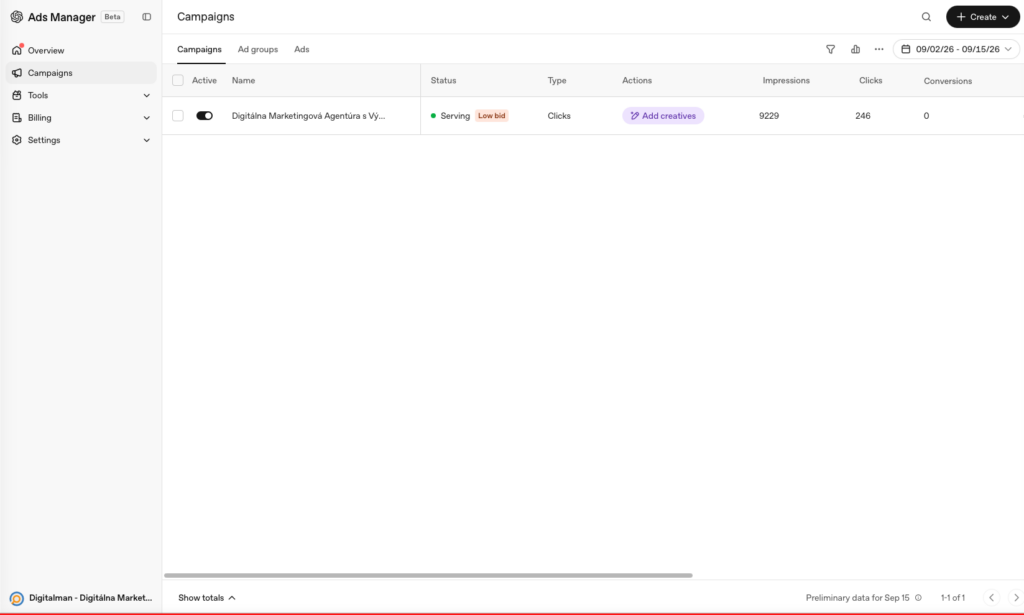
These numbers are not a benchmark: one campaign, a short period, a small data set. The 2.67% click-through rate does show that users respond to well written ads in the chat. The absence of conversions, on the other hand, shows why a new channel should not be labelled “works” or “doesn’t work” after two weeks. Above all, we now have hands-on experience of how campaigns are set up in Ads Manager and what data the platform provides.
What’s new in autumn 2026
- Sponsored Agents (since 16 September, test in the US): after clicking, the user starts a separate conversation with a brand’s agent and can ask questions about the product.
- Creative optimisations on by default (since late October): ChatGPT may rewrite and translate headlines and copy, adjust images and change the destination URL without each version being approved. The feature can be turned off, which we recommend for clients with strict copy requirements (healthcare, finance, legal).
- Ads in image generation: a new visual format, so far as a test in the US.
- New Conversions page and more tracking partners such as AppsFlyer, Adjust, Branch or Triple Whale.
ChatGPT Ads vs Google Ads vs Meta Ads
| Channel | Main signal | When it reaches the customer |
|---|---|---|
| Google Ads | search term and keywords | during active search |
| Meta Ads | audience, behaviour, content | while scrolling, without active search |
| ChatGPT Ads | conversation context and intent | while researching, comparing and deciding |
We do not currently see ChatGPT Ads as a replacement for Google Ads or Meta Ads. If those channels work for you, it makes more sense to add ChatGPT Ads as an extra test channel than to move budget away from them.
Is it worth testing now?
For some businesses yes, for others not yet. We see the biggest potential for companies whose customers research and compare before buying: B2B services, software and SaaS, online shops with products that need explaining, education and more expensive products with a longer decision. If, on the other hand, a business lacks a good website or clean conversion tracking, or its core channels do not work yet, ChatGPT Ads will not solve those problems.
We recommend a controlled pilot of around 90 days: set up tracking, create several themed ad groups and then decide on your own data whether to scale, adjust or stop. Finding out that the audience is too small or clicks too expensive is a valuable result too.
Frequently asked questions about ChatGPT Ads
Are ChatGPT Ads available in the UK and Europe?
Yes. Since 31 August 2026 the self-service OpenAI Ads Manager has been available to advertisers in 31 European countries.
What is the minimum budget?
For an account in euros, €15 per day as an average over 7 days. For a one month test, allow around €450 of ad budget.
Do paying ChatGPT users see ads?
No. Only adult users of the Free and Go plans see ads.
Can I use custom audiences in Europe?
Not at the moment. In the EEA and Switzerland personalised advertising is not available yet, and targeting is based on context, country and device.
Find out more about how we set up campaigns on our ChatGPT Ads page. The first 60 minutes of consulting are free: book a consultation.
Sources: OpenAI: ChatGPT ads expands across Europe, OpenAI Help: Ads in ChatGPT, the basics, OpenAI Help: Launch campaigns, OpenAI Help: Conversion measurement, OpenAI: Reimagining advertising with AI

Test ChatGPT Ads
Want to know whether advertising in ChatGPT makes sense for your business?
In a free 60 minute consultation we assess your potential in ChatGPT and propose a pilot campaign. No obligation, online via Teams or Google Meet.